How Small Businesses Can Use Creativity to Refresh Marketing and Build Loyalty

Image by Kathy McCabe & OpenAI

Local small business owners face a daily marketing challenge: getting noticed in a crowded feed and a busy neighborhood without sounding like everyone else. When promotions blur together, marketing creativity becomes the difference between being briefly seen and being remembered, strengthening brand differentiation in ways discounts can’t sustain. The most effective local business marketing isn’t louder; it uses thoughtful customer engagement strategies that invite genuine audience relationship building over time. Creativity keeps a brand relevant, emotionally resonant, and easier to choose again.

Understanding Creative Marketing Principles

Creative marketing is not random “cute ideas.” It is using novelty, smart improvements, and feeling to make your message easier to notice and remember. In plain terms, creativity in marketing means offering valuable, unique solutions to real customer problems.

This matters because attention is scarce, and sameness is expensive. Novelty helps your posts, signs, and offers earn a second look, while ongoing innovation keeps you from feeling outdated. Emotion turns a one time buyer into someone who feels connected because relationships with brands can feel personal.

Think of a neighborhood cafe. A playful “mystery pastry” week gets people curious, a new ordering shortcut reduces friction, and a story about a family recipe builds warmth. With these principles clear, a simple workflow can turn ideas into consistent campaigns.

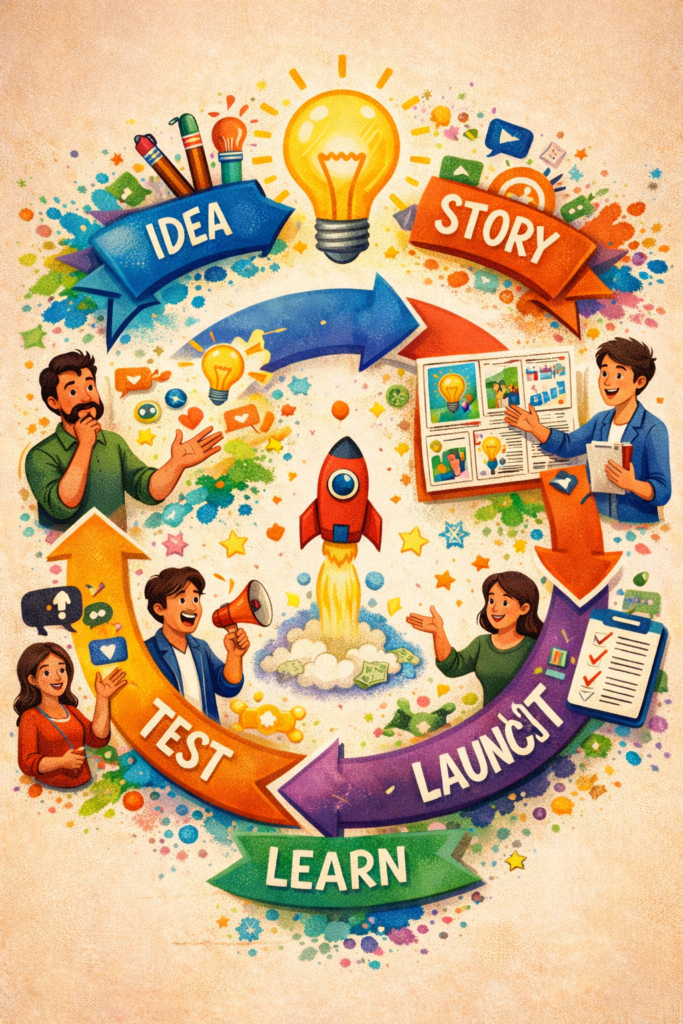
Idea → Story → Test → Launch → Learn

Creative work sticks when it has a cadence, not a burst of inspiration. This lightweight cycle helps you generate fresh angles, turn them into simple stories, and ship small experiments that earn attention without draining your team.


Stage Action Goal
Notice Collect questions, complaints, and “why us?” moments all week Find real problems worth creative attention
Shape Pick one theme; write a one sentence story promise Create a clear narrative spine
Sketch Draft 3 hooks, 1 visual idea, 1 offer, 1 call to action Build options fast, without overthinking
Test Run a small version in one channel for 48 to 72 hours Learn what earns replies, clicks, or foot traffic
Expand Repackage the winner across email, signage, and social Make one idea do more work
Review Log results, customer quotes, and next improvement Turn outcomes into next week’s inputs


As you repeat the loop, insights from Review sharpen what you Notice, and testing protects you from betting on guesses. Over time, your best themes become recognizable, while your execution stays fresh.

Try 10 Fresh Engagement Plays—Plus a Fast Visual-Prototyping Method

When you run marketing on repeat, audiences start to scroll past, even when your offer is solid. Use these plays to keep your “Idea → Story → Test → Launch → Learn” loop moving, so you’re refreshing how you communicate without reinventing your business every week.

  1. Run a two-hook “micro A/B” test before you design anything: Write two versions of the first line for the same post (e.g., “Stop wasting your lunch break” vs. “Make lunch feel like a reset”), then publish each on different days at the same time. Track one simple signal for 48 hours, saves, replies, link clicks, and keep the winner for your next batch. Small tests reduce guesswork and protect your budget by proving the angle before you invest in visuals.
  2. Rotate 3 social branding “containers,” not random styles: Pick three repeatable formats like “tip card,” “behind-the-scenes photo,” and “customer mini-story,” then stick to a consistent font and color palette in all three. The creativity happens inside the container: change the headline, example, or CTA each time. This builds recognition while preventing the feed from looking copy-pasted.
  3. Design for authenticity, not perfection: Use quick, real moments, packing an order, prepping ingredients, setting up a class, paired with one helpful sentence. Social audiences often reward realness, and 62% of users say they care more about authenticity than polished content. Aim for “clear and human,” not “studio.”
  4. Turn one story into a 5-post sequence that invites replies: Map a simple arc: Problem → “What most people try” → Your approach → Proof → Next step. In each post, add one question that’s easy to answer (“Which option fits your week, A or B?”) to spark engagement. This keeps your storytelling consistent across channels and gives you built-in content for the “Learn” step.
  5. Use interest targeting that’s specific without being tiny: If you run paid social, build one persona and add multiple related interests so your audience doesn’t get overly narrow. Many practitioners suggest a recommended size between 300,000 and 500,000 users for interest audiences so the platform can actually find the right people. Then create two ad sets: one “broad-ish” interest group and one location-based group, and compare results.
  6. Prototype 12 on-brand visuals in 20 minutes with a “prompt kit”: Create a mini template you can reuse: brand colors, 2 fonts, 6 keywords that match your vibe (e.g., “calm,” “bold,” “minimal”), and 3 recurring photo subjects (product flat-lay, hands at work, happy customer moment). Feed that kit into a simple image generator or layout tool to produce variations fast, then choose the top 2–3 to refine, click here for more on one option you can use to generate pixel-art style visuals. You’ll avoid repetitive posts while keeping your visuals consistent enough to feel like you.
  7. Add a one-week “refresh cadence” so creativity doesn’t stall: On Monday, pick the story and offers; Tuesday, write hooks; Wednesday, prototype visuals; Thursday, schedule; Friday, review what performed and save examples to a swipe file. This light structure makes your marketing feel steadier and makes it easier to troubleshoot common roadblocks like time, budget, and “I’m out of ideas.”

Used together, these plays keep you experimenting in small, safe ways, so you can stay consistent, learn faster, and build loyalty without burning out.

Marketing Creativity FAQs for Small Businesses

Q: How can I be creative without spending a lot?
A: Start with copy and angles, not new designs. Many businesses with 10 or fewer employees operate with lean time and money, so reuse what you already have and change the hook, headline, or customer example. Commit to one tiny test per week so results guide where you invest.

Q: What if I’m not “a creative person”?
A: Creativity is often a system, not a personality trait. Pick one repeatable format you can follow, then swap the story, question, or offer each time. If you can explain a tip to a customer, you can turn it into content.

Q: How do I know if a fresh idea is working?
A: Tie each experiment to one clear signal like replies, saves, bookings, or email sign-ups. Using measurable goals keeps decisions calm and practical, especially when results are mixed.

Q: When should I stop changing things and stay consistent?
A: Keep your core message steady and rotate the delivery. Stay with a winning theme for 3 to 4 weeks, then adjust one element at a time so you can tell what helped.

Q: Can creativity build loyalty, not just likes?
A: Yes, when it reduces friction and makes customers feel seen. Share behind-the-scenes standards, quick how-tos, and customer wins, then invite small responses that shape your next offer.

Build Loyalty Through One Small Creative Marketing Habit

When marketing feels repetitive and results feel unpredictable, it’s easy to default to “safe” messages that blend in. A creative mindset, curiosity, small experiments, and consistent reflection, keeps your brand clear and human without requiring a full overhaul. Over time, the benefits of marketing creativity show up as steadier attention, stronger customer loyalty building, and long-term brand growth you can actually track. Creativity in marketing isn’t a burst of inspiration; it’s a repeatable habit. Choose one creative habit to practice this week, like reframing one message from a customer’s point of view and noting what response it gets. That kind of compounding creative marketing impact is one of the most reliable small business success tips for staying resilient and connected.

Eleanor Wyatt

 

How to Build a Modern Professional Development Plan That Actually Works for You

Image from Pexels

You don’t need a career coach to tell you that drifting isn’t a strategy. Whether you’re climbing the corporate ladder, launching your own business, or pivoting into something new, direction matters — and so does design. A good professional development plan isn’t a list of vague hopes; it’s a living structure. Done well, it becomes your compass, not your cage. But too many people treat it like a checklist instead of a tool for evolution. This isn’t about being rigid. It’s about staying clear-headed when distractions multiply and energy fades. Here’s how to build a plan that holds up through shifts, setbacks, and seasons.

Start With Structure, Not Pressure

Before you fill out another worksheet or download a template, pause. The first move isn’t tactical — it’s architectural. You need a structure that doesn’t collapse under momentum shifts. That starts by breaking your goals into clear steps, not vague dreams. Think of your plan like scaffolding: it should support progress without locking you in place. Focus less on ambition and more on translation. What does growth look like this month? How would you measure it in real life, not on a spreadsheet? Anchor your thinking in clarity — it’s what gives your plan both flexibility and force.

Define Goals With Real Consequences

“Grow professionally” is not a goal — it’s a placeholder. Your goals should be friction-ready: detailed enough to resist distortion under stress. That’s where using professional SMART criteria makes a difference. It’s not about acronym-worship; it’s about language that holds you accountable. Specific. Measurable. Attainable. Relevant. Time-bound. You don’t need to obey it religiously — but you do need to write goals that survive bad moods and low energy. Good ones will. Bad ones will vanish the moment urgency kicks in.

Build Friction Buffers Around Admin

You can’t grow if you’re drowning in forms, compliance, and back-office noise. Delegate early, even if it feels premature. Use an online formation service like ZenBusiness to strip away the parts of entrepreneurship that drain focus but don’t build skill. Administrative friction doesn’t just steal time — it steals momentum. And without momentum, even the best development plan gathers dust.

Treat Learning Like a Utility, Not a Luxury

No one has time to “keep up” — which is why you need to make upskilling automatic. That doesn’t mean enrolling in a new certification every quarter. It means baking learning into your daily inputs: the articles you read, the people you follow, the way you debrief projects. Growth doesn’t always look dramatic; often it looks like embracing lifelong knowledge-building. Stack that over time, and you’ve got transformation. Ignore it, and you’ll eventually be outrun by someone who didn’t.

Don’t Chase Mentors — Design Guidance Loops

Mentorship isn’t magic. But it is momentum, when done right. The key is not finding “the one” but building structured mentorship relationships. Think of it like an accountability circle — someone a few steps ahead, not a guru. Ask sharper questions. Stay curious, not clingy. And give back when it’s your turn. Most careers don’t advance in a straight line; they zigzag on insight and recalibration. Mentors make that recalibration faster, and a little less lonely.

Track Without Turning Into a Robot

Progress is rarely obvious in the moment. That’s why your plan needs reflection built in. Once a month, stop. Look at what worked, what didn’t, and where the friction is hiding. You’re not just tracking — you’re diagnosing. Set scheduled milestones to check advancement, not to judge progress harshly, but to recognize patterns you’d otherwise miss. A year from now, those notes will be gold.

Make Strategy the Spine, Not the Surface

Professional development is strategy, not scheduling. If your plan doesn’t map back to the life you’re trying to build, start over. And be ruthless about alignment. Not every opportunity deserves your time, even if it sounds impressive. Start aligning roles with your career vision instead of reacting to what lands in your inbox. Strategy means you get to say “no” faster — and with less guilt. That’s the freedom structure buys you.

A professional development plan isn’t a performance review cheat sheet. It’s a pattern of choices that add up to a life. Make it clear. Make it usable. Revisit it often — especially when you feel stuck. Because being stuck isn’t failure. It’s feedback. Your job isn’t to have all the answers. It’s to build a system that keeps you asking the right questions and moving forward even when things get weird. That’s what a good plan does: it doesn’t just map growth — it survives it.

Discover how Hilltop Secretarial Service can transform your business operations with expert virtual office assistance, and join the ranks of satisfied clients who have trusted us for over 25 years!

Eleanor Wyatt

Why Starting a Business After a Career Setback Can Be the Best Move You Ever Make


Image via Pexels

Losing a job or shutting down a business can feel like being thrown off a cliff with no warning. One moment you’re standing on stable ground, the next you’re scrambling just to breathe. The financial worry is immediate, but what often hits harder is the emotional weight. Whether you saw it coming or not, a career setback cracks the foundation you thought was secure, leaving you to sort through the pieces and figure out what matters now.

Feeling Every Part of It Before You Let It Go

There’s no shortcut through grief, and when a career ends—whether by choice or force—it’s still a loss. You don’t just lose income, you lose identity, routine, and direction. People often try to push through too quickly, burying those emotions under productivity or distractions, but that doesn’t work. Giving yourself the time and space to grieve is not a weakness; rather, it’s the first step toward building something healthier and stronger.

Stacking the Deck in Your Favor With Better Tools

One way to work smarter this time is to build a support system that helps you stay focused on what really matters. Hiring a virtual assistant lets you delegate time-consuming tasks like scheduling, emails, or research. You save money compared to hiring in-house and get back hours you can invest in strategy or sales. If you want experienced, reliable help without the overhead, take a look at what Hilltop Secretarial Service has to offer—they specialize in helping business owners keep their day-to-day running smoothly so you can lead without burning out.

Marketing Is About Connection Not Just Promotion

Getting the word out matters, especially when you’re rebuilding from scratch. AI video tools can help you market your comeback without needing fancy cameras or editing skills. These platforms are built for people like you—just type in a description and they generate a polished, custom video. An AI video generator for small businesses can help you craft your origin story, pitch video, or product explainer in a way that feels authentic and connects with your audience fast.

Starting a Business Means Rewriting the Rules

If you’ve ever thought about building something of your own, this could be your moment. Maybe you’ve got a hobby that solves a real problem or a skill you’ve used for others that you can now offer directly. You could start freelancing, consulting, building products, or even launching a service you wish had existed when you needed it. The point isn’t to build the next billion-dollar empire overnight—it’s to build something that feels right and gives you control over your work and your life.

Seeing the Hustle Differently When It’s Yours

Working for yourself isn’t about working less—it’s about working with purpose. You’ll probably put in long hours, especially in the beginning, but every step feels different when it moves you closer to something that’s yours. The freedom to shape your day, your brand, and your values is powerful. There’s no boss to impress and no company ladder to climb, just a path you build with each decision you make.

Building Momentum Without Burning Out

Pacing yourself is one of the most overlooked parts of running a business. When you’re fueled by urgency and ambition, it’s tempting to sprint every day, but that leads straight to exhaustion. Instead, set up rhythms that let you grow sustainably—daily well-structured routines, time blocks, and clear finish lines. When you honor your energy instead of draining it, your business becomes something that adds to your life instead of consuming it.

Using Community as a Secret Weapon

Going solo doesn’t mean going it alone. Surrounding yourself with other business owners, mentors, or even online groups can keep you grounded and inspired. They’ll remind you that the ups and downs are normal and give you ideas you never would have reached on your own. Community turns isolation into momentum and gives you the kind of support that keeps you standing when things get hard.

You’ll mess up. Everyone does. But each small win, each challenge met, builds something deeper than just business skills—it builds trust in yourself. That’s the real power in starting over: realizing that even after being knocked flat, you can still rise, build, and create something that reflects the best of who you are now.

Discover how Hilltop Secretarial Service can transform your business operations with expert virtual office assistance, and join the ranks of satisfied clients who have trusted us for 29 years!

Eleanor Wyatt